Thursday, August 31, 2006

A place that celebrates Roald Dahl


http://www.roalddahlmuseum.org/

Our biographical displays on Roald Dahl and the interactive fun of the Story Centre will be on display permanently, so you’ll be able to enjoy them time and time again. But we also have some space for temporary exhibitions:
'Roald Dahl's Songs and Verse'17 June 2006 - 26 November 2006
This wondercrump new exhibition features a dazzling display of original artwork from an international line-up of illustrators from the 2005 Roald Dahl book, 'Songs and Verse'. Visitors can read (and hear) some of their favourite Roald Dahl poems and find out about some that they may not have seen before!
We are running 'Songs and Verse' craft activities and crodsquinkling competitions for the chance to win a bag of Museum goodies. Find out more when you visit the Museum.
We are very grateful to all the artists who have generously loaned their artwork, and to Random House Children's Books for their sponsorship, making the exhibition possible.

Wednesday, August 23, 2006

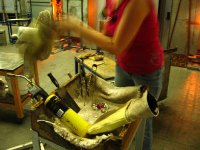
Stephanie Metivier Glassblower

Stephanie is a member of the Fusion Program at Espace VERRE


Saturday, August 12, 2006

Brian Jungen exhibition

Yesterday,my friend James and I went to see this exhibition. We really enjoyed it!
Prototype for New Understanding #8, 1999 Nike athletic footwear, human hair

Cetology, 2002 Plastic chairs
Brian Jungen
is at the Contemporary Museum of Montreal
from May 27 to September 4, 2006
185, Sainte-Catherine Ouest (corner Jeanne-Mance)
Montréal, Québec H2X 3X5
Telephone : (514) 847-6226Fax : (514) 847-6291
E-mail: info@macm.org

This exhibition, the first survey of the work of the young Vancouver artist Brian Jungen, presents pieces produced in the last decade. Jungen’s art draws inspiration from both his analytic and sometimes humorous observation of contemporary consumer culture and his ancestral ties with the Dane-zaa Nation of northern British Columbia. Here, the famous Nike running shoes take on the form of ceremonial West Coast Native masks, while plastic lawn chairs are transformed into enormous whale skeletons. These works call into question the various economic, sociological and cultural values of the Western world, at the same time as they initiate a dialogue between Aboriginal and global cultures.The exhibition, organized by Vancouver Art Gallery, was realized by Daina Augaitis, assistant chief and main curator of the institution, with the support of the Audain Foundation and The Andy Warhol Foundation for the Visual Arts. The presentation to the Musée d'art contemporain is under the coordination of the curator Réal Lussier.
Want to know more about Brian Jungen:

Thursday, August 10, 2006

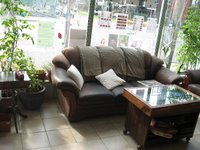
Café de l'artiste Verdun

(All photos are by Jade Delorme)

5200 Verdun
Verdun, QC H4H 1K1
Tel: 514.362.8436
Fax: 514.362.0045
Come and visit sometime...

Meet Tara Slade-Hall the owner...

You can find Fine Crafts...

Discover some incredible artists...

Eat great food, drink

coffee, tea or fruit smoothies

in a great atmosphere

where you can take classes, meet interesting people and watch great shows on the Weekends...

Some of the shows scheduled for August 2006:

(Although admission is free, a donation of at least 5$ is suggested)

Next Show:


Atacamenos Aug 11 2006 Peruvian music

Upcoming shows:

Moise Mathey, Fabrice Koffey: Music type : World - Poetry (music)
Yves Lanneville, Anick Bérubé: Aug 18 2006, soirée franchante
Robert Levasseur: Aug 19 2006, songs and poetry
Mike Burns: [Stage]Aug 25 2006, reading
Marndmelissa: Aug 26 2006

Saturday, August 05, 2006

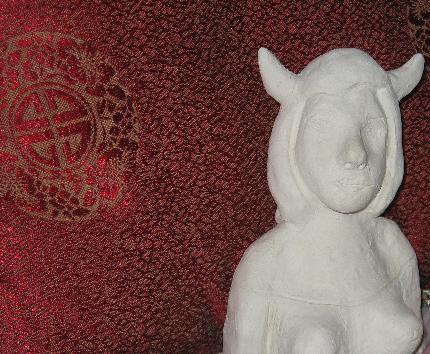
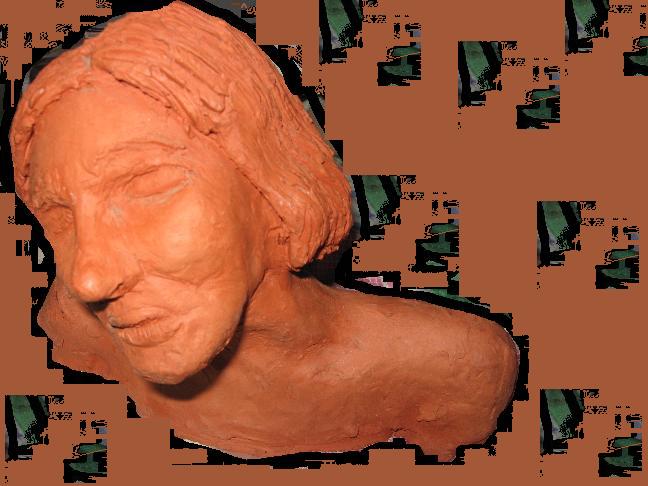
Ceramic Sculptures in progress

Weaving project in progress (2006)

Devilish girl yet to be painted (2006)


Old woman (2006)

Bust from 1992
The last ceramic sculpture that I had done

Friday, August 04, 2006

My Verdun neighbourhood


Karine(R) from the Cafe de l'artiste
with her sister Stephanie on Verdun Avenue
Another restaurant across the street
they make a great submarine sandwiche and
Cesar salad...

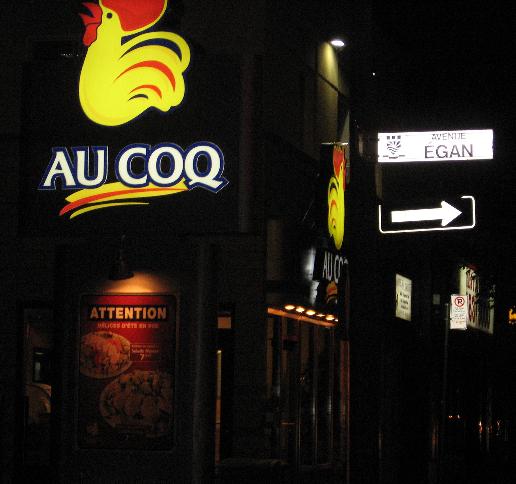
Rotisserie style chicken

Fresh QC corn special

A small market a few blocks away
on Verdun Avenue

A poster for a slush drink at the Couchetard corner store

The building where I live on Moffat Street

Tuesday, August 01, 2006

Three Art Shots

Vanishing Hand

Neon Strip Club Sign

Domestic Shiva

Sunday, July 30, 2006

A few photos taken going to work


This shot is from the corner (Wellington and Bridge streets) bus stop where I have been getting off every morning, for almost five years, to go to work...I have always wondered about how this one was achieved without detection and wether they were Japanese...
This is the entrance to my work
on Mill Street about 5 minutes from the other corner
Espace VERRE means Glass Space
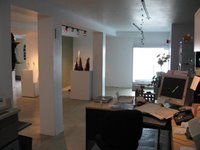
This is my desk in the gallery...

Graduation Exhibition 2006

Monday, July 24, 2006

Come and celebrate the mystery and reality of the "Feminine Mystique"

Painting by Sorange Castillo

Feminine Mystique
featuring: Sorange Castillo,
Shelley Shanks, Aimi Dunn,
Ann Hernandez and more...
Friday, July 28, 6:00 pm to 9:00 pm

Earth Gallery
365 W. 19th Street
Houston, TX
Telephone: (713) 880-2121
www.earthgalleryonline.com


Friday, July 14, 2006

Georgia O'keefe at the Shelburne Museum


Hibicus and Plumeria (1932)
Simple Beauty: Paintings by Georgia O'Keeffe exhibits some 25 works by one of the most admired American artists of the 20th century. Included are sublime landscapes of the American Southwest, breathtaking close-up views of flowers, abstract paintings, still-lifes, and city and farm scenes that are not widely known. Several works have rarely been on public view, and many date from the 1920s when the public was just beginning to recognize her importance as an artist. Read more...
Shelburne Museum
U.S Route 7, P.O Box 10
Shelburne, VT 05482
Phone: 802.985.3346
Fax: 802.985.2331

Wednesday, July 12, 2006

EMILY CARR EXHIBITION


Emily Carr: New Perspectives
2 June to 4 September 2006
Ottawa, Canada - 6 March 2006. This summer, the National Gallery of Canada pays a unique homage to Emily Carr, modern painter, writer, environmentalist, feminist icon of Canadian art, defiant Victorian, solitary eccentric, and documenter of Northwest Coast monumental art. On display in Ottawa from 2 June to 4 September, Emily Carr: New Perspectives, presented by Sun Life Financial, looks at this much-loved artist through the historical lens of 20th century exhibitions that presented her work, and in the social and political contexts that defined her world. The exhibition is coorganized with the Vancouver Art Gallery.
Best known for her paintings of First Nations villages and landscapes of the northwest Pacific coast, Emily Carr (1871-1945) is the subject of numerous biographies, scholarly articles, documentary films, plays, a musical, an opera, and poetry. "Born the same year British-Columbia joined Confederation, she has contributed in her very own way in the making of our country's identity," says Pierre Théberge, Director of the National Gallery of Canada. (read more http://www.national.gallery.ca/emily/en/media/) .
NATIONAL GALLERY OF CANADA
380 Sussex Drive, Ottawa
613.990.1985 or 1.800.319.ARTS

Sunday, July 09, 2006

Important women artists part 1

Diane Arbus
Double Self-Portrait With Infant Daughter, Doon, 1945
Early life
Arbus was born in New York City into a wealthy Jewish family, in which she was overshadowed by her older brother, the poet, Howard Nemerov. Arbus fell in love with future-actor Allan Arbus at age 14, and married him soon after turning 18, despite her parents' objections. When Allan started training as a photographer for the US Army, he taught Diane his lessons. She also learned about photography through photographer, Lisette Model. The Arbuses ran a successful fashion photography studio for 20 years, before separating in 1959. The Arbuses had two daughters, photographer Amy Arbus and writer and art director Doon Arbus.
[edit]

Photography career
After separating from her husband, Arbus studied with Alexey Brodovitch and Richard Avedon. Beginning in 1960, Arbus worked extensively as a photojournalist, her photos appearing in Esquire, The New York Times Magazine, Harper's Bazaar and Sunday Times magazines, among others.
Arbus' early work was created using 35mm cameras, but by the 1960s Arbus adopted the Rolleiflex medium format twin-lens reflex. This format provided a square aspect ratio, higher image resolution, and a waist-level viewfinder that allow Arbus to connect with her subjects in ways that a standard eye-level viewfinder did not. Arbus also experimented with the use of flashes in daylight, allowing her to highlight and separate her subjects from the background.
In 1963, Arbus received a Guggenheim fellow grant, allowing her to focus on her art. Arbus received a second Guggenheim grant in 1966. The Museum of Modern Art, in 1967, staged Arbus' first museum show as the New Documents show which included the work of Garry Winogrand and Lee Friedlander. Arbus also taught photography at the Parsons School of Design in New York and Hampshire College in Amherst, Massachusetts.
In July 1971, Arbus ended her own life in Greenwich Village, at the age of 48 by ingesting a large quantity of barbiturates and then cutting open her wrists. Rumors held that she photographed her suicide, but no photos were discovered by the police.
Aperture magazine was crucial in reviving Arbus' artistic reputation. MoMA curator John Szarkowski prepared to stage a retrospective in 1972, but the accompanying Diane Arbus catalogue proposal was turned down by all major publishing houses. Aperture's Michael E. Hoffman accepted the challenge, producing one of the most influential photography books. The Aperture monograph has since been reprinted 12 times, selling more than 100,000 copies. The MoMA retrospective traveled throughout North America attracting more than 7 million viewers. Also in 1972, Arbus became the first American photographer to be represented at the Venice Biennale. Arbus' photograph, Identical Twins is sixth on the list of the list of most expensive photographs havings sold in 2004 for $478,400.
Arbus is remembered today for her photographs depicting outsiders, such as tranvestites, dwarves, giants, prostitutes, and ordinary citizens in poses and settings conveying a disturbing uncanniness. Some critics claim that Arbus' voyeuristic approach demeaned her subjects. In 2005 Germaine Greer made this claim on BBC Culture Show, based around a major London retrospective of Arbus's works. Admirers of Arbus's work (such as Todd Solondz) were also interviewed by the BBC and passionately defended her work.
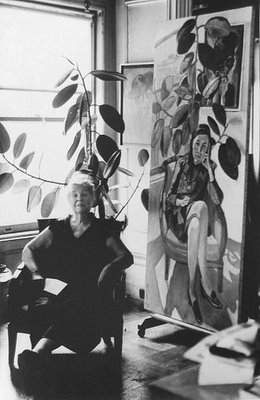
Isabel Bishop

Laughing Head, 1938

Isabel Bishop (March 3, 1902March 19, 1988) was an American painter and graphic artist, who produced numerous works of mainly working women in an urban realist style. She was widely exhibited in her lifetime, and was recognised with a number of awards including one for Outstanding Achievement in the Arts, presented to her by President Jimmy Carter in 1979.
Bishop was born in Cincinnati, Ohio and brought up in Detroit, Michigan, before moving to New York City at the age of 16 to study illustration at the New York School of Applied Design for Women. After two years there, she shifted from illustration to painting, and attended the Art Students League for four years until 1924. During the early twenties she studied and painted in Woodstock. Much of her early work exhibits a range of study and styles. Although she never took off from landscape painting many of the early paintings exhibit landscape like examinations of lighting, trees, still-lifes, and street scenes often in a forced 1:3 landscape ratio. Early pieces are often on pressboard. Few early works survived her noted self-destruction of her own pieces from the early period left in her studio in the 1970s. She became a life member of Art Students League and taught there from 1936 to 1937.
Many of Bishop's mid to later works depict the inhabitants of the New York's Union Square area, where she maintained a studio between 1934 and 1984. Her subjects are nearly always women and, particularly in earlier works, some come from a blue-collar background, yet she was also known to produce beautiful panoramic studies of the country and social scenes such as golf tournaments. The portraits are portrayed often as an individual head – the emphasis securely on the subject's expression – or as a single nude. As well as these, many of Bishop's compositions contain two females engaged in various interactions. Her signature changed many times over her career from using various pseudynoms to initials signing some early pieces I.B, or I. Bishop in both block and scrpit

Saturday, July 08, 2006

Important women artists part 2


Camille Claudel
She was born in Fère-en-Tardenois, Aisne, in northern France, the second child of a family of farmers and gentry. Her father, Louis Prosper, dealt in mortgages and bank transactions. Her mother, the former Louise Athanaïse Cécile Cerveaux, came from a Champagne family of Catholic farmers and priests. The family moved to Villeneuve-sur-Fère while Camille was still a baby. Her younger brother Paul Claudel was born there in 1866. Subsequently they moved to Bar-le-Duc (1870), Nogent-sur-Seine (1876), and Wassy-sur-Blaise (1879), although they continued to spend summers in Villeneuve-sur-Fère, and the stark landscape of that region made a deep impression on the children. Camille moved with her mother, brother and younger sister to the Montparnasse area of Paris in 1881, her father having to remain behind, working to support them.
[edit]

Creative period
Fascinated with stone and soil as a child, as a young woman she studied at the Académie Colarossi with sculptor Alfred Boucher. (At the time, the École des Beaux-Arts barred women from enrolling to study.) In 1882, Claudel rented a workshop with other young women, mostly English, including Jessie Lipscomb. In 1883, she met Auguste Rodin who taught sculpture to Claudel and her friends.
Around 1884, she started working in Rodin's workshop. Claudel became his source of inspiration, his model, his confidante and lover. She never lived with Rodin, who was reluctant to end his 20-year relationship with Rose Beuret. Claudel never had children with Rodin, although she was pregnant. She lost the child in an accident[1], which sent her into deeper depression. Knowledge of the affair agitated her family, especially her mother who never completely agreed with Claudel's involvement in the arts. As a consequence, she left the family house. In 1892, perhaps after an unwanted abortion, Claudel ended the intimate aspect of her relationship with Rodin, although they saw one another regularly until 1898.
Beginning in 1903, she exhibited her works at the Salon des Artistes français or at the Salon d'Automne. It would be a mistake to assume that Claudel's reputation has survived simply because of her notorious association with Rodin. She was in fact a brilliant sculptor in her own right, as good as the best of her peers. Her early work is similar to Rodin's in spirit, but shows an imagination and lyricism quite her own, particularly in the famous Bronze Waltz (1893). The Age of Maturity (1900) is a powerful allegory of her break with Rodin, with one figure The Implorer that was produced as an edition of its own. Her onyx and bronze small-scale Wave (1897) was a conscious break in style with her Rodin period, with a decorative quality quite different from the "heroic" feeling of her earlier work. In the early years of the 20th Century, Claudel had patrons, dealers, and commercial success - she had no need to bask in the reflected light of Rodin. However, this success was not to last.
From 1905 on, Claudel acted mentally deranged. She destroyed many of her statues, disappeared for long periods of time and acted paranoid. She accused Rodin of stealing her ideas and of leading a conspiracy to kill her. After the wedding of her brother (who supported her until then) in 1906 and his return to China after a stay in France, she lived secluded in her workshop.
[edit]

Confinement
Her father, who approved of her career choice, tried to help her and financially supported her. He died on March 2, 1913 and no one informed Claudel of his death. On March 10, 1913 at the initiative of her mother, she was admitted to the psychiatric hospital of Ville-Évrard in Neuilly-sur-Marne. The form read that she had been "voluntarily" committed, although her admission was signed by a doctor and her mother.
In 1914, to be safe from advancing German troops, the patients at Ville-Évrard were at first relocated to Enghien. On 7 September 1914 Camille was transferred with a number of other women, to the Montdevergues Asylum, at Montfavet, six kilometres from Avignon. Her certificate of admittance to Montdevergues was signed on 22 September 1914; it reported that she suffered "from a systematic persecution delirium mostly based upon false interpretations and imagination".
For a while, the press accused her family of committing a sculptor of genius. Her mother forbade her to receive mail from anyone other than her brother. The hospital staff regularly proposed to her family that Claudel be released, but her mother adamantly refused each time. On June 1, 1920, physician Dr. Brunet, sent a letter advising her mother to try to reintegrate her daughter into the family environment. Nothing came of this.
Paul Claudel, her brother, visited her every few years, though he referred to her in the past tense. In 1929 Jessie Lipscomb visited her.
Camille Claudel died on October 19, 1943, after having lived 30 years in the asylum at Montfavet (known then as the Asile de Montdevergues, now the modern psychiatric hospital Centre Hospitalier de Montfavet), and without a visit from her mother or sister. (Her mother died on June 20, 1929.) Some biographies list her death as 1920. Her body was interred in the cemetery of Monfavet.


Important Women Artists part 3

Sofonisba Anguissola, Self-Portrait, 1554.
Sofonisba Anguissola was born in Cremona. She was the oldest of seven children, six of whom were daughters. Her father, Amilcare Anguissola, was a nobleman. Sofonisba's mother died shortly after her children were born. Amilcare, who bore a name from antiquity (i.e. the name of the Carthaginian Hamilcar, as did his son Asdrubale, named after Hasdrubal) named her after the tragic Carthaginian figure Sophonisba.
All of the daughters (Sofonisba, Elena, Lucia, Europa, Anna Maria and Minerva) possessed artistic talent. Asdrubale did not study painting, but studied music and Latin like his sisters did. Along with second oldest sister, Elena, Sofonisba formally studied art with Bernardino Campi, a local portrait painter. When Campi moved to another city, Sofonisba continued her studies with the painter Bernardino Gatti. Sofonisba's apprenticeship with local painters set a precedent for future women to be accepted as students of art.
Later in life, her sister Elena became a nun, and two sisters ended their art careers after marriage, whilst the last sister died at an early age.
In 1557, her father Amilcare wrote a letter to Michelangelo describing the talents of his daughter. By way of response, the prominent artist sent him a drawing for his daughter to copy, as was the custom of the time. Sofonisba drew "Child bitten by a crab" and sent it back to Michelangelo for criticism; her talent was immediately recognized by Michelangelo.
In 1559, in her late 20's, her talents recognized, she was invited to Spain to serve as a court painter and lady-in-waiting to the Queen, Elizabeth of Valois, whom she painted in 1565. Sofonisba remained for 10 years. She married twice. Her first marriage in 1570 was to Fabrizio de Moncada, a Sicilian. The wedding ceremony was celebrated with great pomp, and she received a dowry from the monarchs Philip II of Spain and Elizabeth. Sofonisba spent the next four years in Italy, but when her husband Fabrizio died, Sofonisba decided to return to the Spanish court. However, on her return voyage, she fell in love with the ship's captain, Orazio Lomellino, and they married on arrival to the port of Genoa.
Sofonisba became a wealthy patron of the arts after she became blind. She had three children and spent the rest of her life in Genoa and Palermo.
In 1624, one year before her death (she claimed to be 96 at the time), Sofonisba was visited by a young Anthony Van Dyck, who drew a portrait of her in his sketchbook and noted that, though Sofonisba was blind, was still quite mentally alert. Excerpts of the advice she gave him about painting also survive from this visit.
She died in Palermo in 1625.

Artemisia Gentileschi Self-portrait

Artemisia Gentileschi (1593 - 1652/1653), daughter of well-known Roman artist, Orazio Gentileschi (1563 - 1639), was one of the first women artists to achieve recognition in the male-dominated world of post-Renaissance art. In an era when female artists were limited to portrait painting and imitative poses, she was the first woman to paint major historical and religious scenarios.
Born in Rome in 1593, she received her early training from her father, but after art academies rejected her, she continued study under a friend of her father, Agostino Tassi.
In 1612, her father brought suit against Tassi for raping Artemisia. There followed a highly publicised seven-month trial. This event makes up the central theme of a controversial French film, Artemisia (1998), directed by Agnes Merlet.
The trauma of the rape and trial impacted on Artemisia's painting. Her graphic depictions were cathartic and symbolic attempts to deal with the physical and psychic pain.
The heroines of her art, especially Judith, are powerful women exacting revenge on such male evildoers as the Assyrian general Holofernes. Her style was heavily influenced by dramatic realism and marked chiaroscuro (contrasting light and dark) of Michelangelo Merisi da Caravaggio (1573 - 1610).

After her death, she drifted into obscurity, her works often attributed to her father or other artists. Art historian and expert on Artemisia, Mary D. Garrard notes that Artemisia "has suffered a scholarly neglect that is unthinkable for an artist of her calibre." Renewed and overdue interest in Artemisia in recent years has recognized her as a talented seventeenth-century painter and one of the world's greatest female artists.
Find out about other women artists: http://en.wikipedia.org/wiki/Category:Women_in_art

Wednesday, July 05, 2006

Michael-Ann Belin's Solo Exhibition


"Coming out of the Metaphysical Closet"
Michael-Ann Belin
blows the hinges off the doors with her newest works.
Come meet this extraordinary artist and transcend earthly bonds. .

Opening: Saturday, July 15, 2006 7 until 10pm
Where :
M2 Gallery
325 W. 19th St.
Houston, TX 77008
Phone : 713.861.6070

Email : m2-houston@sbcglobal.net

Wednesday, June 28, 2006

Art poems that I have written

TB HARLEM by Alice Neel

Images
images of an alice neel painting tb harlem
a youthful victim of it's ravaging
come to me while i listen to the tb sheets song by van morrison
the flash is unmistakably vividin my brain's eye
i can feel the young man's suffering
with a collapsed bandaged lung
concaved rib cage deformed
by medical intrusive intervention
i can only imagine the pain
that he is feeling and think of him
as eternally clinging to a life scarred and wasted
and I can almost smell the decaying
of his once youthful flesh
caught in the act by paintbrush verity
on a striking canvas repose
which no spectator can ever deny
is the work of a true genius
and a masterpiece of life


Painting Dance
painting dance
and refrains untapped
i see the colors
of the strokes and the movement
inside the darkness of my mind
i apply the coup de grace
that marred the purity of the rawness on my canvas
with a first trace of paint
all in the name of symbolism
behind the shield of artistry
for a fleeting momen
ti grasp the true meaning
behind the unknown forces that give me guidance
through each step
but alas in a flash
it is gone
and i have
forgotten


Museum Sleep

inside the ornate frame

such beauty rests in a museum sleep

frozen in silence waiting

for cracks to formin the plaster wall

to breathe again

to regain life

in ancient fibers of morrow's lore

and furthermore the pallid beauty

wearing those woven golden reddish braids

longs for the creator's touch

the lover's embrace

the passionate kiss


Suzanne Delorme

Tuesday, June 27, 2006

Marcel Duchamp 1887-1968

Art Historians Recognize Duchamp as the Greatest Influence in 20th century art

Check it out : http://www.marcelduchamp.net

Wednesday, June 21, 2006

3 Women artists inspirational quotes

I cannot solve the problem of life by losing myself in the problem of art. (Tina Modotti)

At no point do I wish to be in conflict with any man or masculine thought. It doesn't enter my consciousness. Art is anonymous. It's not competitive with men. It's a complementary contribution. (Barbara Hepworth)


Like Chekhov, I am a collector of souls... if I hadn't been an artist, I could have been a psychiatrist. (Alice Neel)